Brand and products
Markets: price, offer, claims
The facts that change per country, kept per country, and what never crosses.
Last updated 24 October 2026

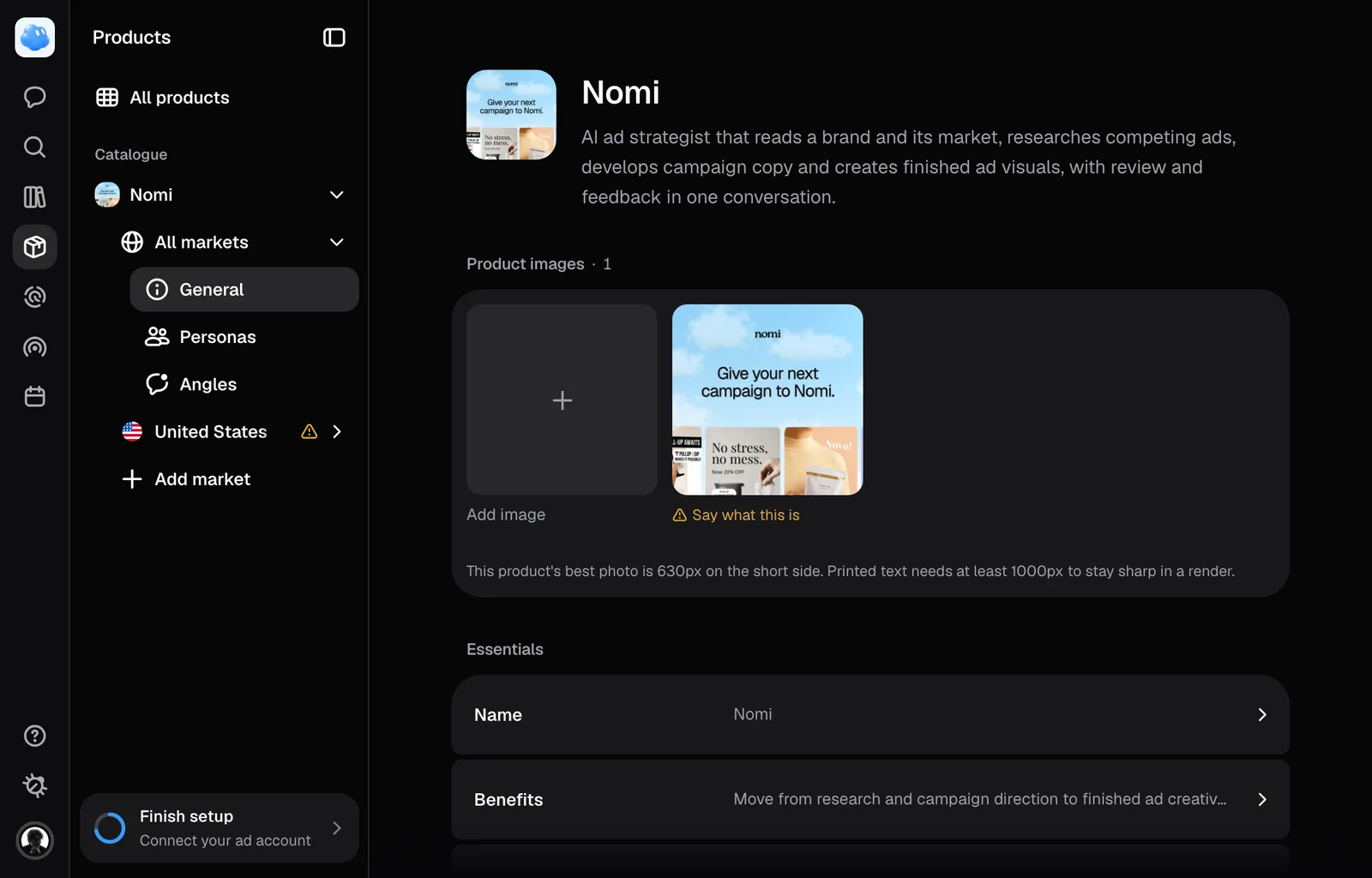
A product's price is not one number. It changes at the border, and so do the offer, the wording you are allowed to use, and the page the ad points at. A market is where those facts live, one set per country, so a German ad never quotes what you charge in the States.
The Products sidebar keeps the catalogue visible. Open a product, then a market to reach its own General and Angles. A market with missing details shows the full warning below its title and description.
What a market is
A market is a country and a language, and they are two separate answers, not one.
That split does real work. Switzerland can be one market or three. Germany and Austria are two markets in one language: same words, different price, different page.
In the Products sidebar, open the product and press Add market under its markets. Type a two-letter country code, and the country's name appears under the field once it resolves, then the language that market's ads are written in and, if you have it, that market's own landing page. With a page, Nomi saves it as the market's landing and reads it the way Add product reads one, and fills in what the page says for the market it belongs to. You can also just ask Nomi for it in a session. And when Nomi builds a product from a page it read, it makes the first market out of that page's own currency and language, then says which market it took it for so you can correct it.
Nomi can add a market in a session too, when you ask for work in a country the product does not sell in yet, but only for a brand admin, the same as Add market; anyone else is told to ask an admin.
The six answers a market owes
Six things belong to a market and never carry across a border: the product's name in that market, the price, the offer, the claims you may make, a packaging picture tagged to that market, and at least one landing page.
Claims you may not is the exception in that group. That is wording which is never allowed anywhere, so it is written once for the whole product.
Nomi will not borrow another market's price, offer or claims to fill a gap. A missing one stays missing and it asks you for it.
Reading a product through one market
Open a product from the Products list. Its contextual sidebar has General and Angles. General shows the product's shared answers, with Markets underneath in the sidebar. Choose a market to read its own values. Angles belong to the product, so a market shows the same list. On a phone, open the sidebar to reach the same sections.
A field the market has not answered shows the product's value with Inherited beside its label, so you can see it is borrowed. The six above are never borrowed: they stay empty until that market answers them.
A market still short one of the six carries a warning mark in the sidebar, and pointing at it says what is missing. Its page says the same under its name, with Use the product's answers, which copies the product's own answers in as that market's, and Add landing page when it has none; a count at the foot says how many of the six are filled. Pictures and landings each belong either to all markets or to one, so a market's page does not offer anything tagged to a different market.
Before you generate
If a product sells in more than one market, Nomi asks which one an ad is for before it draws, because nothing records that afterwards.
Remove market is under Danger zone at the foot of the market's page. It asks first, and what goes is that market's own answers. The market itself stays, so another product can still sell there, pictures and landings keep their tag, and ads already made for it are untouched. There is no undo.
Still missing something?